Anna
Anna stood behind the glass wall from isolation, waiting to speak to her family who’d flown to the Baikonur Cosmodrome to watch her launch. Roscosmos, the Russian Space Agency’s main facility on the southern steppe of Kazakhstan was the largest spaceport in the world and the site where both the first Soviet satellite and man were launched into space. While this history was not lost on Anna, she wasn’t particularly moved by sentimentality, in this circumstance or in any other.
A United States Naval Academy aeronautical engineering graduate and fighter pilot, Anna had flown operational missions over Iraq during the invasion and later. Her pilot nickname had been Frosty, because when it came down to it, she was stone cold. Cool in the cockpit and over enemy territory, she was neither rude nor unapproachable. Anna never betrayed her emotions, remained calm as she worked a problem, and always brought her aircraft home.
At 5’6”, her build appeared average, but under her flight suit she was physically fit and had a muscular frame. In preparation for space flight, she’d worked to increase her muscle mass to protect herself from the debilitating effects of zero gravity on her body for her six-month mission to the International Space Station. Her light brown hair was kept short out of practicality, and her hazel eyes never betrayed her thoughts.
Anna had never been outgoing, but she was the team member everyone wanted because her calmness was contagious. It was what pushed her to the top of her class at the Naval Academy, flight school, and made her the best pilot in her squadron. When she was accepted into the Astronaut program, Anna stood apart from her peers. NASA rewarded her by assigning her to the first mission after she finished training, and here she was, hours away from her first launch, and years ahead of the astronauts she’d been selected with five years before.
Last Farewell
Looking at her husband Tim through the window, holding their two boys by the hand she smiled and waved at them. Not because she’d wanted to, or through natural reflex, but because she knew it was an expected emotional response under the circumstances. Looking closely at her boys, she wondered if anyone had noticed the growing resemblance between her three-year-old son Jack, and his father, Jacques. Jacques was her crewmate and fellow astronaut, the charming Frenchman, now on the microphone saying goodbye to his family.
Jacques was tall, sincere and the most handsome man Anna had ever known. He was both a scientist and engineer, and the two had met right after Anna had been picked for the Space Program. What few knew was that like Anna, Jacques was a master of his emotions, but unlike her, he focused on appearing warm and engaging. This strategy he once told her after sex, was the key to his success, and although it could be tiresome, the advantages far outweighed the minimal intellectual effort it took.
Anna could mimic emotions too but rarely did because she’d been successful without having to. She did find certain emotional affects helped in child rearing and as a socially acceptable mother, but beyond that, she did little more than remember to be pleasant.
That she and Jacques were now destined to travel to the ISS for six months was irrelevant to their relationship. While both enjoyed interacting without having to fake sentiments that weren’t there when they were alone, they remained professional. Neither had to say meaningless words to each other, or waste time considering the other’s feelings. They spoke plainly in a manner more emotional people would describe as ‘frank.’
Over the course of several years, they agreed it was the most enjoyable interaction with another human being either of them had ever had. To them, it really made little difference in how they viewed each other. They would go months at a time without speaking, as they had during training. They looked forward to seeing each other but didn’t missed one another when they were apart.
They only communicated on work-related matters through their government email accounts, and had anyone cared to read them, they wouldn’t have detected their sexual relationship or friendship.
Their sexual relationship had only begun when Jacques agreed to father her second child. When Anna approached him in Huston, she stated that she did not want another simpering and needy child like the one she’d produced with Tim. She deduced if Jacques impregnated her, it was more likely the child would have more self-control and therefore be easier to raise. Jacques agreed, and within two months, she was pregnant.
She had agreed to have two children with Tim, in conjunction with her training schedule. She became pregnant during the academic periods of training and gave birth during her programmed vacation time each time. In exchange, Tim agreed to stay home with the babies and allow Anna to return to work immediately after giving birth.
When it was time for the second child, using the Rhythm Method, Anna calculated the most and least likely times of the month during her cycle to conceive. Only having sex with Tim during the least likely times, and with Jacques when she was most fertile seemed to have produced the expected result. Looking at Jack through the window, standing beside his father, quietly and without complaint, while his brother Timmy fidgeted restlessly pleased her. If only she’d met Jacques sooner she lamented.
Lift Off!
Seated inside the descent module of the Soyuz, high above launch Pad 31, they’d already been strapped in for nearly two hours. Anna sat to Yuri, the Russian pilot’s left, in the Flight Engineer’s position. Jacques, with no assigned flight duties, sat to Yuri’s right.
Looking over her instruments in response to the checklist items Yuri called out, she reported each back to him in the sequence. A check list they’d practiced hundreds of times in training.
On completion of the checklist, the Commander’s flight controls were activated. Yuri then ordered the crew to close their helmet visors in preparation for lift off. Inside the rocket launch control bunker, the launch key was inserted, completing, but not closing the launch control circuit. Because everything occurred on a fixed timeline, Anna instinctively knew they were at T minus five minutes without looking at the countdown timer.
“Internal power on,” Anna reported in Russian, which she learned so she could be the Flight Engineer. The clock was at T minus 60 seconds.
“Da,” Yuri acknowledged. The second-generation Cosmonaut’s voice was calm and professional. A veteran space traveller, this was his fourth Soyuz launch and second as commander. His experience did not make the launch routine easier, but Yuri was the embodiment of the sort of man the early American astronauts referred to as a ‘steely-eyed missile man.’ Yuri was a man at the top of his field and it was obvious to everyone who worked with him.
Jacques sat silently. His heart rate was so low Mission Control in Huston had already reset his biometrics monitor once, thinking it was glitching; it wasn’t.
“Auto sequence start engaged.” Anna deadpanned at T minus 35 seconds. Outside the 3rd stage ground power umbilical cord tower could be heard separating from the rocket. A second tower separated 15 seconds later.
In Facility №169, less than 500 metres away, the firing team prepared for liftoff. In a cement building designed to withstand both earthquakes and a rocket explosion, they were so close they would feel the launch vibrating through their bodies.
“Klyuch na Start!” The Launch Director’s command to turn the launch key. It was the final launch order. Unlike NASA’s solid fuel rockets, the Soyuz’s liquid fuel could be shut down after ignition; a safety feature the American rockets didn’t have.
Anna felt the first real vibrations coursing through her seat at T minus ten seconds when the engine’s turbopumps began spinning at top speed as the Soyuz was spooled up to full power. At T minus five seconds, she felt the full power of the engines rumbling below, and her body began shaking. Tensing her leg muscles, she locked herself into her seat to compensate for the vibrations blurring her vision. This mimicked a trick she learned when launching from aircraft carriers. By tensing her body, her eyes steadied enough to read the instrument panel through the vibration.
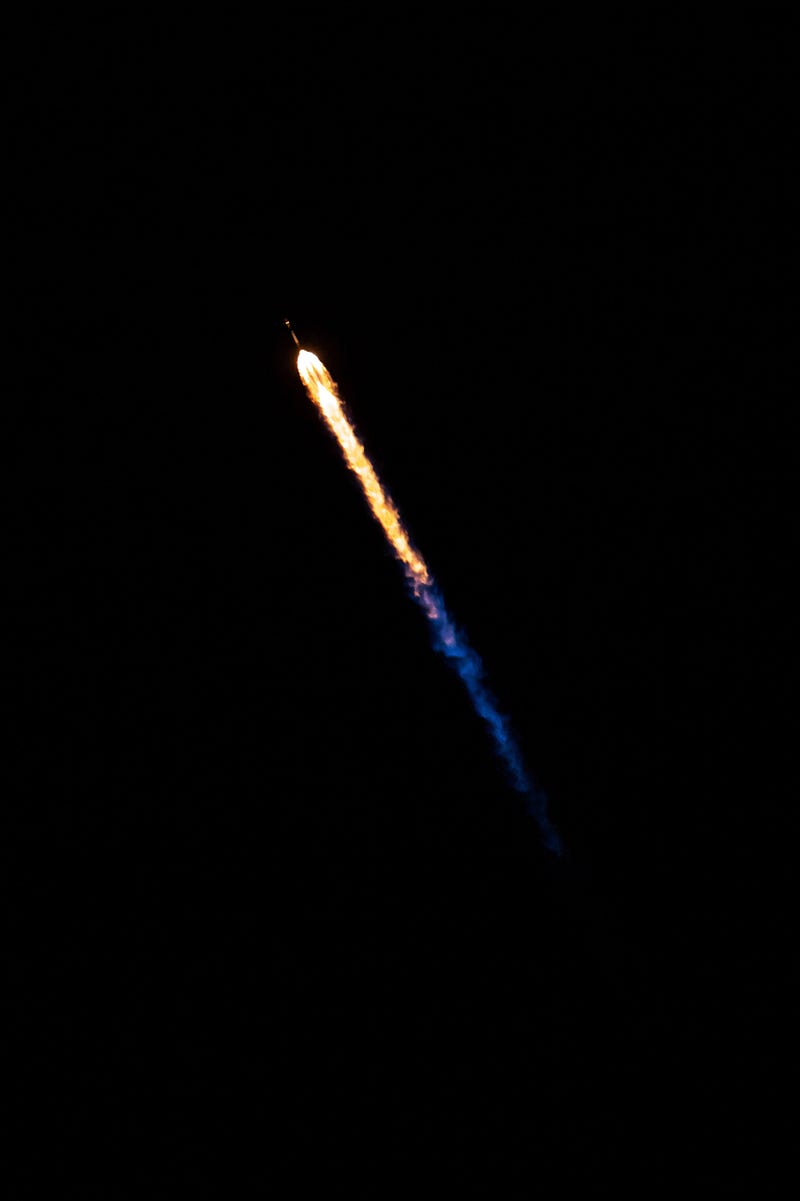
At T minus zero, her whole world shook as the rocket cleared the launch pad. The Soyuz pressed her back in her seat, hard. Focusing on the fuel pressure flowing through the engine, she felt a dampness growing between her legs as they rocketed skyward. The flex in her legs to keep her vision steady caused the rocket’s vibrations to pass through her labia into her clit. There was no way she could do her job if she unflexed, and if she didn’t, she would cum in the next 120–140 seconds.
Quickly working the logic, she knew she needed to focus until the first stage boosters departed at T plus 118 seconds. Already ten seconds into the flight, she had to hold off her orgasm for at least 110 seconds more until they reached 148,500 feet, so she could monitor the booster rocket separation.
That would give her 20 seconds to get over the most significant part of her orgasm and 20 seconds to reorient before the payload fairing split in two and separated at 160 seconds. After that, she could rest for 90 seconds before the second stage separated.
“First stage separation complete. Pressure good. Engine good. Second stage firing within parameters.” No sooner had she given her status report than the first pulse of her orgasm radiated through her. She could feel her heart pounding as her eyes roll back in her head and her breath caught in her throat. Squeezing tightly, she accepted the orgasm as inevitable and did everything in her power to hasten it’s passing. But god damn it, it was just as amazing as the girls said it would be.
Anna wasn’t emotionless, she could just control them to the point they disappeared; the state she most preferred. Except when she had sex. During sex, she used her control to heighten her physical experience, and it worked marvellously. It was that skill she harnessed to quickly move through the most powerful orgasm she’d ever had.
As the third wave crested she released pressure on her legs and a powerful jet of fluid rushed out of her vagina flooding her adult diaper. She’d never squirted before and thought the orgasm combined with the g-forces caused it. Thank god for diapers she thought.
In Huston, the bioscience officer monitoring Anna’s life signs isolated the first 160 seconds of her health record from the main data stream and marked it ‘Discrete Access — Medical Staff Only.’
The bioscience team was becoming familiar with the ‘unusual’ biorhythmic pattern female astronauts experienced in the first 180 seconds of flight on the Soyuz. Some speculated that the Soviets stopped flying women for 20 years after Valentina Tereshkova, the first woman in space on Vostok 6 in 1963, because she too experienced a ‘physical abnormality’ during launch.
At first, NASA was alarmed when it began happening, but then it became apparent the big Russian rocket had a certain way with the ladies. Impressively though, the desk officer observed, Anna, lasted the longest before coming. She also appeared to have had one of the most powerful orgasms based on the raw physiological data, but also inexplicably, one of the shortest ‘events.’ I’d love to be a fly on the wall in that debriefing she smiled,
“Anna must be a remarkable lady.”
Find out what Anna and Jacques get up to on the ISS in part two!
Join my email list — HERE and get a free pdf copy of my ebook —
© Teresa J. Conway, 2020