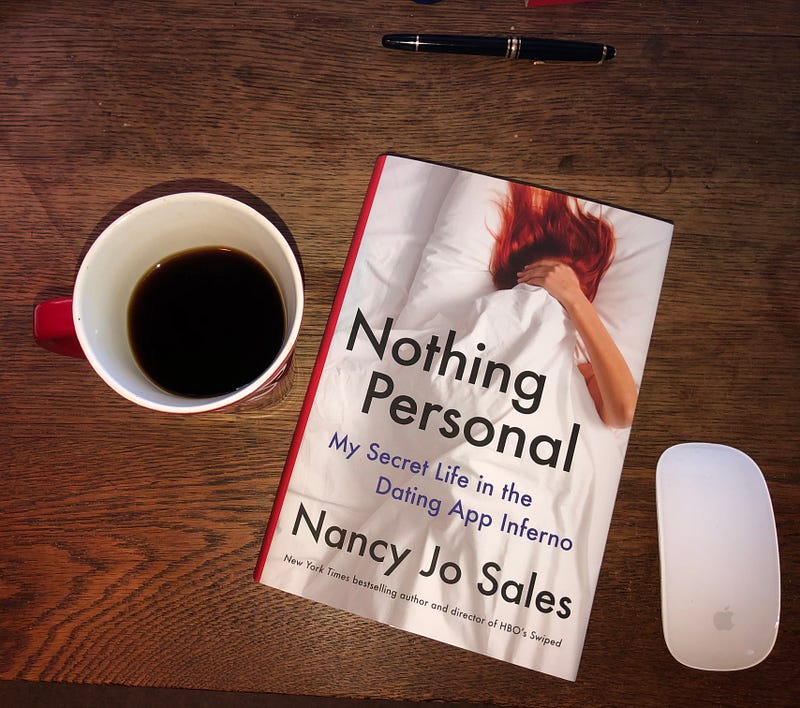
Nothing Personal: My Secret Life in the Dating App Inferno
Nancy Jo Sales
Hatchet Books
372 pp
Released — 18 May 2021
The “dinner and a show” date is dead, and sadly, what’s replaced it isn’t pretty. Read along as Nancy describes in detail what your daughter means when she tells you she’s got a Tinder date.
You won’t like it, or the reason why it’s happening.
What’s happening to our children at the hands of data companies masquerading as matchmakers reveals a level of exploitation on a massive scale. A scale Nancy knows first-hand, having experienced the worst of hookup culture in the encounters she describes.
A hookup culture where our kids find themselves drinking to excess to have deliberate stranger sex all the while pretending it’s casual. A culture where our daughters can feel compelled to trade sex with uncomfortable men to get out of difficult situations. A culture where our children’s main sexual education comes from Pornhub, which teaches them choking and violent sex a necessary part of the act.
The consequences of which are played out throughout Nancy’s interviews. Interviews with our children. Children we’ve failed.
I’m a not pearl clutcher — far from it. As a married woman who went without sex for a decade, I meet strangers for sex online. I understand the fears, exhilaration, and letdowns of hooking up with strangers.
But I have a home, and life to go back to. I need the anonymity of online dating apps like Ashley Madison and Adult Friend Finder to fulfill my sexual needs that aren’t met at home, but when it comes to your young, online dating is something far more insidious.
Raising an alarm about the dangers of dating apps, she gives a clear and compelling first-hand account of the online dating scene. It’s a difficult read. Not only does Nothing Personal expose the dating industry for what it is, but it also exposes Gen X and Boomer parents for who weare.
We’re the parents who handed our children over to data companies like we were sending lambs to the slaughter.
I’ll warn you that Nancy likes sex with young men. You’ll likely hear her work judged for that, and you’ll do it yourself. But ignore her preferences, because her message is far more important.
You don’t have to like what Nancy likes. Instead, consider the men Nancy meets are the same men your daughter meets. Seeing them through Nancy’s eyes will give you insight into what your daughter sees in the men she dates.
And what they see is something I’m sure they could never tell you themselves.
This alone makes this book worth reading for every parent with dating aged children. It’s easy to call our children adults, but in looking at what they face through Nancy’s eyes will show you the suffering dating apps have thrust upon them.
Nothing Personal is raw, uncomfortable, and perplexing at times, but don’t let that distract you from the message. What Nancy experienced — the danger, the unfulfilling sex, and the heartbreak of relationships that are neither here, nor there — is what your children are experiencing.
It will make you uncomfortable and it should.
Having studied youth for over two decades Nancy weaves her professional and personal lives together as she dissects the dating app industry, its motivations, its effect on users, and how that shapes the relationships they form. Nancy’s first-hand experience with the apps began during her cross-country interviews subjects for her 2018 HBO documentary, Swiped.
Nancy examines the idea that tech companies exploit users by tapping into their brain’s dopamine reward system (3rd party link). Discovered in the 1950s using self-stimulating rats who released their own dopamine by pressing levers, saw them became addicted to lever pressing.
Think of people sitting at slot machines in Vegas for hours on end. Social media giants design their apps to engage this system using likes and swipes, which each deliver small hits of dopamine that quickly wear off until they swipe again.
Dating app makers design their platforms to entrap users the same way.
Nancy touches on the apps’ promotion of racism and exclusion of the LBGQT+ communities, but those are only incidental to her focus — the apps harmful impact on young women.
Citing increases in sexual violence, teen suicide, and the erosion of feminist gains of the 60s, Nancy argues the tech companies and the bro culture they’re founded on do little to protect women.
Nancy criticizes the lip-service the app companies pay to user safety when it’s evident sexual predators stalk the sites. Citing her own experience of being violently choked by a match who claimed he thought women liked it is but one example where blurred understandings of consent and preferences can lead to physical and emotional harm.
Despite her user-based experience and research, what’s missing from her examination of the problems with “big dating” are practical solutions to the dangers she sees. Nancy offers none. Coming up short in providing practical safety options for users is surprising and as such is the only place Nothing Personal falters.
In my own experience with dating apps, I understand why she lacks solutions. There’s a complexity to online dating safety that makes the challenge difficult to understand.
In researching my own security-based book on how to conduct an affair, I examined the risks posed by the apps in detail. I did so because while I recommend strangers as the safest affair partners, strangers also pose the most physical risk to the adulterer on their initial meets and sex dates.
In looking at dating safety to avoid the situations Nancy describes, my conclusion was there is little that can be done by anyone other than the user. When in-app articles outlining the personal security measures users should take were suggested by a dating app CEO as one-way apps worked to protect users, Nancy outright rejected them.
Unfortunately, in my assessment, only personal security measures or not using the apps will keep women safe.
When you consider women have been sexually exploited since the beginning of time, it is not hard to imagine why societies would evolve to protect their women from strangers.
When you examine the historic treatment of women, and the manner the access to their sexuality was restricted, you see the artifacts of how societies once worked to protect them.
Consider that cultural adaptation is purpose-driven, not accidental, and you will understand how sexual repression was used to limit the non-familial sexual abuse of women.
In this sense do dating apps expose a more fundamental reason why societies repressed women’s sexuality? I’m left wondering if we are seeing the rise of a new and more predatory sexual environment with dating apps, as Nancy contends, or the return to outcomes we’ve long strived to overcome?
Is this an avenue she could have explored to further explain the patriarchy and its role in protecting women, and in so doing, offer an alternative to it?
Amongst her outward-focused aggression on the injustice of dating apps, we find Nancy befriending and mentoring the young women who use them.
What shines through is her empathy, compassion, and capacity to love unconditionally. It was likely these things and her easy sexuality that left her vulnerable to the “project” men she attracted.
At times I found myself shouting, no Nancy! You’re better than that! I also found it sad that she couldn’t use the best of her personality traits to protect herself. And nothing satisfied me more than when she kicked the losers in her life to the curb!
By the book’s end, I was left wanting to give her a hug to make up for the ones she’s missed along the way.I’m also thankful for her message because I can now see and better understand what my children are going through on dating apps —
Tech companies have changed dating by taking advantage of our children’s susceptibility by exploiting their dopamine reward systems. They have changed the rules of the game in a way that has destroyed the meaning of a relationship and in so doing have put our daughters and sons in physical and emotional danger.
With Nothing Personal, Nancy warns — the canary in this coal mine is dead.
The question is — what do we do now?